
PHOTON SPIKING NEURAL SYSTEMS
Photon spiking neural systems represent one of the most exciting frontiers in computing, where researchers are building brain inspired processors that operate at the speed of light. By mimicking the spike based communication of biological neurons using photons instead of electrons, these systems aim to overcome the fundamental speed and energy limitations of traditional electronic chips.
Speed of Light. Photonic systems process information at the speed of light, offering vastly higher bandwidth and lower latency than electronic circuits.
Energy Efficiency. Light can propagate and interact with minimal energy loss, promising highly energy efficient computing.
Parallelism. Techniques like wavelength division multiplexing (WDM) allow multiple data streams to be processed simultaneously on a single chip, dramatically increasing computing density.
Device to System. Information Processing
Cascadability and Memory. A fundamental requirement for any computing primitive is the ability to connect multiple units to form a larger system. This 'cascadability' has been demonstrated in a circuit with two interconnected Q-switched laser neurons, which also showed the ability to function as an optical memory element.
System Level Performance. When assembled into small networks, photonic neurons are achieving impressive results. For example, a PSNN using a programmable optoelectronic neuron achieved 89.3% accuracy on the classic Iris dataset. A network based on Spin VCSELs exceeded 90% accuracy on similar classification tasks. Furthermore, a four-layer SNN built with phase change material photonic switches achieved over 92% accuracy on the more complex MNIST digit recognition task.
Key Device Platforms Research
Laser-Based Neurons (DFB & VCSEL). These use the non-linear dynamics of semiconductor lasers to mimic neuron behaviour. For instance, when a vertical cavity surface emitting laser (VCSEL) receives an optical input pulse above a certain threshold, it can be triggered to emit a sharp, high-powered output 'spike,' much like a biological neuron firing. Recent work has shown that these spikes can be cascaded from one distributed feedback (DFB) laser neuron to the next, a crucial requirement for building larger networks. A single VCSEL can even be time-multiplexed to create a network of hundreds of 'virtual' neurons for complex tasks like predicting chaotic time series.
Resonant Tunnelling Diode (RTD) Neurons. RTDs are electronic devices with a region of negative differential resistance, which makes them inherently non-linear and capable of producing ultrafast spikes. By making them photo-detecting, researchers have created hybrid photonic-electronic neurons. A major breakthrough is the demonstration of a 'resonate-and-fire' (R&F) RTD neuron. Unlike simpler 'integrate and fire' models, an R&F neuron is sensitive to the timing of inputs. It will only fire a spike if a second sub-threshold pulse arrives in sync with the resonance of the first, acting as a precise temporal filter.
Novel Approaches. Beyond lasers and RTDs, the field is exploring other innovative ideas. One team used the physics of optical rogue waves to create a passive, energy efficient thresholding mechanism, achieving high accuracy on image recognition tasks without active components. Others have shown that microdisk lasers can perform fundamental digital logic operations, acting as the basis for more complex photonic circuits.
Key Features & Recent Breakthroughs
Mature, off the shelf lasers repurposed as spiking neurons, exhibit key neural behaviours (threshold, integration, refractory period). Breakthrough. Cascadable excitatory/inhibitory dynamics demonstrated in DFB lasers without amplifiers . Single VCSEL used to create a time-multiplexed network with memory for complex tasks.
Speed. Sub-ns refers to delegating a subdomain to a separate authoritative name server using NS records, allowing independent DNS management for that subdomain. Sub-ns spiking responses. Application. Chaotic time-series prediction , sound azimuth detection.
Moving beyond single layer networks to deep, interconnected architectures for enhanced learning. Breakthrough. Introduction of a hybrid two spike (HTS) encoding method for multilayer VCSEL-SA networks
Demonstration of a large scale programmable chip with 16 channels and 272 trainable parameters for all optical reinforcement learning.
Exploring new physical principles and device structures to implement neural functions. Breakthrough. RTD devices used to create 'resonate and fire' neurons sensitive to the timing of optical inputs. Microdisk lasers demonstrated for optical logic gate operations. Passive, energy efficient thresholding achieved using optical 'rogue wave' statistics.
Representative Performance Metrics / Applications
Speed. Sub-ns spiking responses. Application. Chaotic time series prediction , sound azimuth detection.
Accuracy. 82.45% on Breast MNIST, 95% on Olivetti Faces ; 80% on KTH video recognition ; Near perfect scores on Cart Pole/Pendulum control tasks. Energy Efficiency. 1.39 TOPS/W for linear ops.
Functionality. Bandpass filtering of optical inputs , Digital logic gates,; Passive, energy efficient thresholding.
Recent Breakthroughs
Full-Stack PSNN Chip with On Chip Learning. In a landmark achievement in 2025, researchers demonstrated the first PSNN chip on a standard silicon platform that integrates gigahertz speed spiking dynamics and crucially, the ability to learn on the chip. This chip uses a retina inspired encoding method and achieved 80% accuracy on a video recognition task at speeds 100 times faster than conventional methods.
All Optical Reinforcement Learning. Programmable two chip system that performs reinforcement learning entirely in the optical domain. By keeping both linear and non-linear computations optical, it eliminated the speed and energy penalties of converting signals back to electricity. The system learned to balance a pole on a cart in real time, with energy efficiency comparable to GPUs.
Scaling Up with Multi-Layer Networks. To enhance learning capability, researchers have developed multi-layer PSNNs. They also proposed new ways to encode information, such as the 'hybrid two spikes' method, which uses both the timing and strength of spikes to pack more information into the optical signal.
Future Directions and Challenges
Scalability. While small networks are working well, scaling up to thousands or millions of neurons on a single chip comparable to electronic processors is a major engineering challenge. This requires advances in integration, manufacturing, and interconnect technology.
Non-linearity at Low Power. Implementing strong optical non-linearities (essential for neural computation) in a compact, low power, and scalable way is an ongoing quest. Novel approaches like the rogue wave method are exciting steps in this direction.
Path Forward. Researchers are already planning the next steps. This includes designing larger scale chips (e.g. with 128 channels) for more complex tasks like autonomous navigation and demonstrating compact, hybrid integrated systems suitable for real world edge computing applications.
Device Physics
VCSEL & DFB Laser Neurons.
Use laser non-linear dynamics to mimic neuron spiking in response to optical input.
Mature technology, off the shelf components, ultra-small footprint, fast modulation.
Single laser neuron. Uses optical feedback to generate tonic/phasic spiking without multiple lasers. Fully integrated chip. 0.25 mm² InP-based DML-DFB laser neuron chip, the 'highest level of integration' for PSNNs.
Resonant Tunnelling Diode (RTD) Neurons
Exploit the negative differential resistance region of an RTD to create ultra-fast, excitable spikes from electrical and optical inputs.
High speed (ns-rate, sub-ns predicted), low power, inherent photo-sensitivity, multi-modal control.
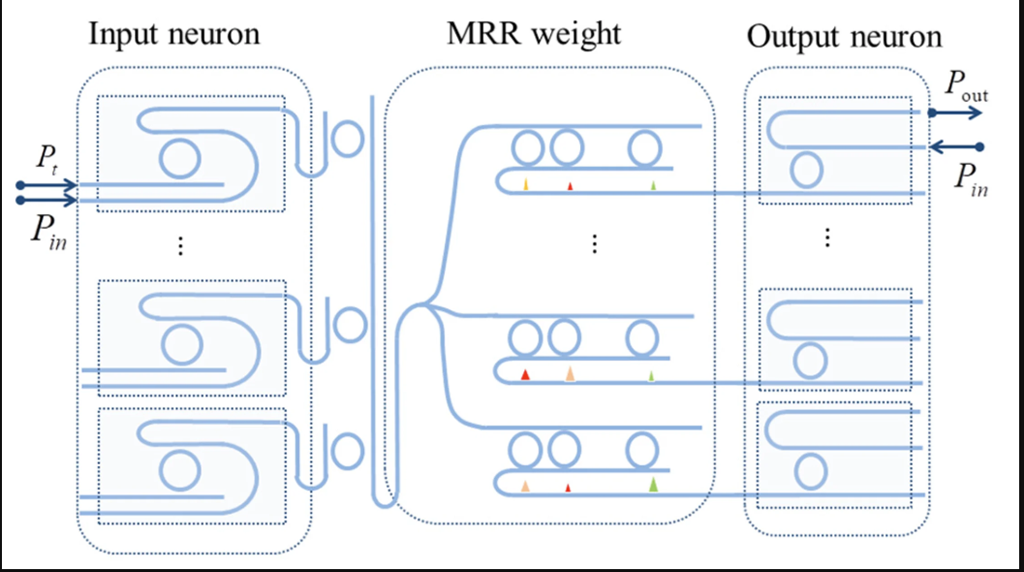
Resonate and Fire (R&F) neuron. Responds to the timing of optical inputs, enabling temporal pattern recognition and bandpass filtering. Multi-wavelength operation. Supports wavelength multiplexed inputs from four VCSELs for enhanced parallelism.
Optoelectronic & CMOS-Integrated Neurons
Combine photonic inputs with CMOS circuitry for non-linear processing, then convert back to light.
High programmability, WDM compatible, cascadable, leverages mature CMOS industry.
Programmable neuron. Can tune four neuron parameters to mimic heterogeneous biological behaviors (e.g. chattering) at 1GSpike/s; achieved 89.3% on Iris dataset. Monolithic silicon resonator. Foundry-compatible design using a mirroring modulator to achieve Class 2 excitability.
Emerging Material & Device Platforms
Novel physics and materials like phase change or spin dynamics for neural computation.
Potential for new functionalities (e.g. non-volatile memory), reduced power consumption, and increased density.
Phase change material (PCM) switches. Use GST to create thermal leakage integrate and fire (TLIF) neurons for on-chip SNNs; achieved >92% accuracy on MNIST. Spin VCSEL neurons. Use optically pumped spin polarized VCSELs to reduce threshold pump power by up to 50%, achieving >90% accuracy on pattern classification.
Q-Switched Laser Neurons
Multi-section laser where a saturable absorber (SA) region 'quenches' the gain, leading to a sudden output spike.
Ultrafast (picosecond scale) response, low power control signals.
All optical neuron. Demonstrated key neural behaviours (excitability, inhibition, integration, refractoriness). Showcased cascadability and optical memory in a two neuron circuit.