The Analogue Optical chip
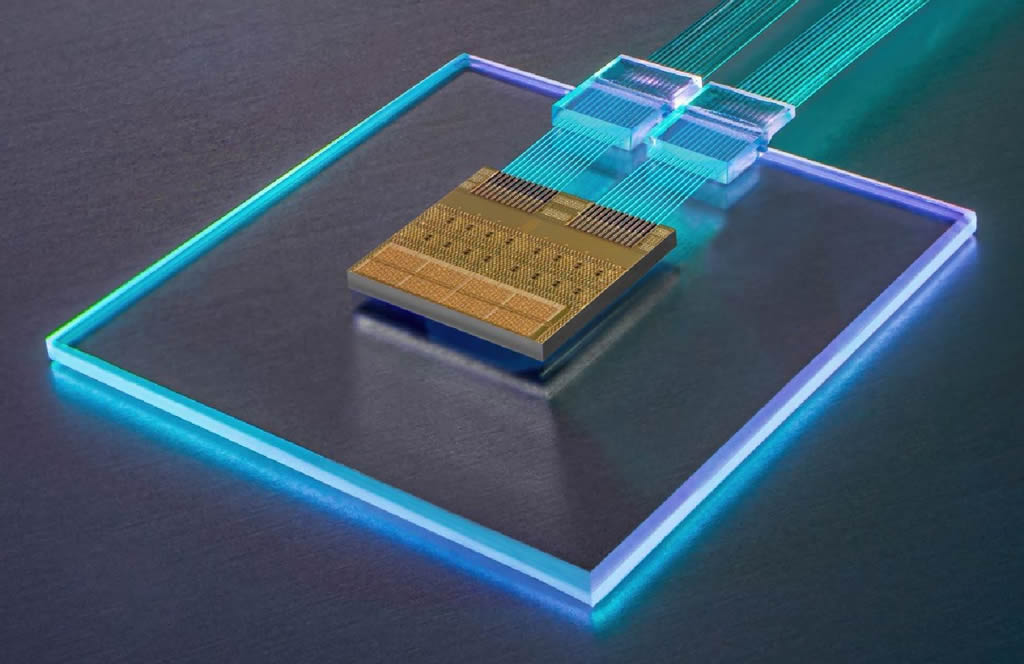
The future of ASPICs is not about replacing digital CPUs for general purpose computing. Instead, they are specialised accelerators for problems where their native advantages are overwhelming. In simple terms, an ASPIC is a chip that uses light (photons) instead of, or in conjunction with, electricity (electrons) to perform analogue computations directly.
Silicon Photonics: The base technology. It is about building optical components (waveguides, modulators, detectors) on a silicon wafer, similar to how electronic transistors are made. This allows for mass production and miniaturisation.
Integrated Circuit: These optical components are interconnected into a complex circuit on a single chip.
Analogue: This is the key differentiator. Unlike digital chips that process information as 0s and 1s, analogue chips process continuous signals. ASPICs manipulate the physical properties of light, its phase, amplitude, and wavelength. To perform mathematical operations on input data directly.
Ultra Low Latency and High Bandwidth Communications
Intra-Data Center Links: The backbone of the internet. ASPICs are already used for optical transceivers that move data between servers at 100s of Gbps with extreme efficiency. The future involves more complex on chip routing and wavelength management.
5G/6G Wireless: For processing millimetre wave signals at cell towers, ASPICs can perform Fourier transforms and beam forming faster and more efficiently than digital electronics, enabling faster, more responsive networks
Artificial Intelligence and Machine Learning
This is perhaps the most promising future direction. Matrix multiplication is the most computationally intensive part of neural network inference.
Optical Neural Networks (ONNs): An ASPIC can be designed where the weights of a neural network are physically encoded in the components of the chip (e.g. the setting of a modulator). The input data, encoded as light, propagates through this network and performs the massive matrix multiplication in a single clock cycle, at the speed of light, and with incredible energy efficiency.
Future Impact: This could lead to AI accelerators that are thousands of times faster and more efficient than today's best GPUs (etc.) for specific inference tasks, enabling powerful AI on edge devices.
Analogue Optical Computing for Scientific Simulations
Some physical systems are inherently analogue and continuous. Simulating them with digital computers is slow and approximation heavy. ASPICs can act as analogue simulators.
Example: An ASPIC's structure could be designed to mathematically mimic a complex molecular interaction or a financial market model. The ‘computation’ is simply observing the output light, which is the solution to the differential equations describing the system.
LIDAR and Sensing
Automotive LIDAR: ASPICs can form the core of solid state, chip scale LIDAR systems. They can control laser beam steering (optical phased arrays) and process the returning signals to create high resolution 3D maps in real time.
Biomedical Sensors: A ‘lab-on-a-chip’ using ASPICs can detect specific biomarkers by measuring tiny changes in the phase or resonance of light interacting with a sample, enabling portable, highly sensitive medical diagnostics.
Quantum Computing
ASPICs are a leading platform for building photonic quantum computers. They can generate, manipulate, and detect quantum states of light (qubits) with the stability and scalability offered by silicon chip technology
Advantages and Challenges
Speed: Computation at the speed of light (~10-100x faster than electrons in a wire for on chip communication).
Bandwidth: Multiple wavelengths of light (WDM) can be used simultaneously, creating massive data parallelism.
Low Latency: Passive processing eliminates clock cycle delays.
Energy Efficiency: Light propagation generates very little heat compared to electron movement through resistive wires.
Immunity to EMI: Light waves do not interfere with each other or with external radio waves.
Challenges
Precision and Noise: analogue systems are susceptible to manufacturing imperfections, temperature drift, and signal noise, limiting their precision compared to perfect digital arithmetic.
Programmability: Hardwired ASPICs are incredibly efficient for one task but inflexible. Creating programmable ASPICs (where you can reconfigure the ‘circuit’)is a major research focus.
Packaging and Integration: Coupling light efficiently from fibres onto the tiny chip and integrating the necessary laser sources remain expensive and complex engineering challenges.
Design Tools: The EDA (Electronic Design Automation) tools for designing complex photonic circuits are less mature than those for electronics
The future of ASPICs is not a standalone one, but one of integration. The ultimate goal is heterogeneous integration, where ASPICs are co-packaged with digital electronic chips (CPUs, GPUs) on the same substrate.
In this future, a compute system would intelligently offload specific, burdensome tasks (massive matrix multiplications for AI, ultra-fast signal processing for communications) to its on chip ASPIC accelerator, achieving performance and efficiency that is utterly impossible with electronics alone. They are a key enabling technology for the next generation of computing, sensing, and communication systems.