
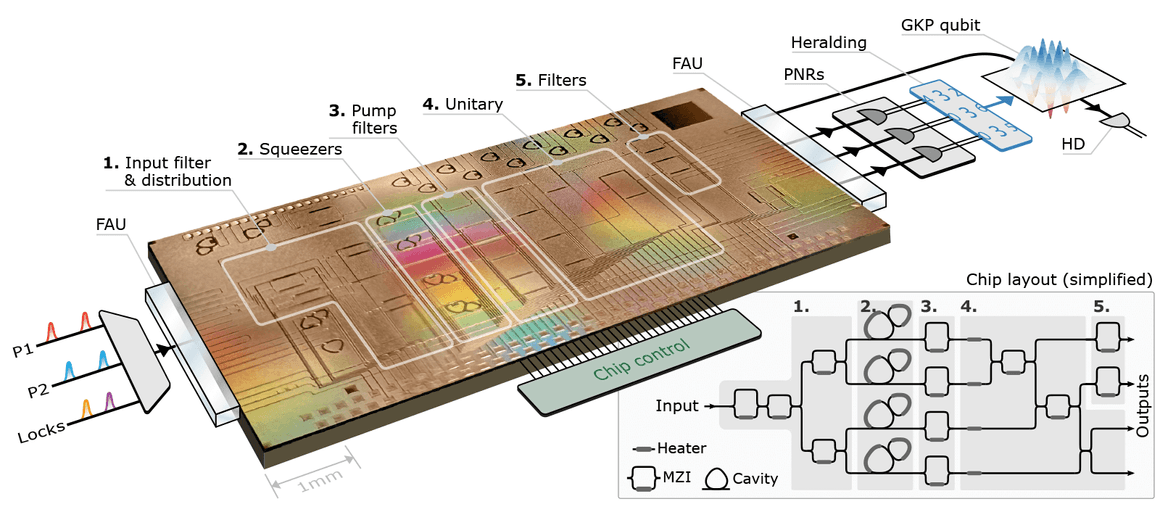
Xanadu is a Canadian quantum computing company that has developed a unique approach to quantum computing using photonic chips. Instead of using superconducting circuits or trapped ions (like IBM or IonQ), Xanadu's processors manipulate individual particles of light (photons) to perform quantum computations.
Continuous Variable (CV) Quantum Computing
Unlike most other quantum computing platforms that use 'qubits' based on the discrete presence or absence of a particle (like an electron), Xanadu uses a Continuous Variable (CV) architecture.
Information is encoded in the properties of light waves, specifically the quadratures (position and momentum) of the electromagnetic field.
The Qumode. The basic unit of computation is not a qubit, but a qumode (quantum mode). A qumode can exist in a superposition of continuous values, allowing for a potentially different computational approach compared to discrete qubit systems.
The Hardware. The 'X' Series Chips
Xanadu's photonic chips are fabricated using existing industrial processes for silicon photonics, which is a major advantage for scalability. Their chips look similar to telecommunication fibre optic components but are designed for quantum states.
X8 Chip. Their first generation of commercially available chips.
Contains 8 qumodes (8 quantum channels).
Fully integrated and programmable via an external fibre connection.
X24 Chip. A larger version, contains 24 qumodes.
X16 (and beyond). They have also developed and tested chips with 16 qumodes, demonstrating a roadmap toward larger systems.
Key Components on the Chip
A Xanadu photonic chip integrates several crucial components onto a single piece of silicon.
Squeezers. To create quantum effects, the light must be 'squeezed.' This reduces the quantum noise in one property of the light (e.g. position) while increasing it in another (e.g. momentum), creating a pure quantum state. This is achieved through a process called Spontaneous Four Wave Mixing (SFWM) within spiral waveguides on the chip.
MZI Arrays (Interferometers). These are programmable mesh networks of beam splitters and phase shifters. They control how the photons (light waves) interfere with each other. By applying voltages to the chip, you can change the paths of the light, allowing for universal gate operations on the qumodes.
Delay Lines. Because light travels very fast, Xanadu's chips use long, spiral shaped waveguides to act as temporary memory, allowing different qumodes to interact with each other at the right time.
Detectors. While the generation and manipulation happen on the chip, the measurement is performed by ultra fast, high efficiency Homodyne Detectors (often external or edge coupled) that measure the wave properties of the light.
The Borealis Breakthrough
In 2022, Xanadu announced a machine called Borealis, which demonstrated quantum advantage (computational supremacy) using their photonic technology. Borealis is a programmable photonic chip with up to 216 qumodes (though not all are used for logic, many are used for squeezing and entanglement. It demonstrated that photonic quantum computers can outperform classical supercomputers on specific tasks (Gaussian Boson Sampling).
Advantages of the Photonic Approach
Room Temperature Operation. Unlike superconducting qubits that require millikelvin temperatures (dilution refrigerators), photonic chips can operate at room temperature. (The detectors sometimes require cooling, but the chip itself does not).
Manufacturing. They can be fabricated in standard semiconductor foundries (CMOS compatible), leveraging the existing multi billion dollar infrastructure of the global electronics industry.
Connectivity. Photons are naturally mobile. It is easier to network multiple photonic chips together using optical fibres than it is to connect separate supercooled devices.
Low Decoherence. Photons do not interact strongly with their environment, meaning they maintain their quantum state for a long time relative to the computation time.
Deep dive into the works
Software Integration
The hardware is designed to be controlled via Strawberry Fields, Xanadu's open source Python library for photonic quantum computing. This allows developers to write code that compiles down to the voltage adjustments on the MZI arrays on the chip.
The Foundational Physics Continuous Variables (CV) and Phase Space
The Qumode vs. The Qubit
Qubit. A two level system ($|0\rangle$ or $|1\rangle$). Its state can be represented as a point on the surface of a Bloch sphere.
Qumode. A quantum harmonic oscillator. Its state exists in an infinite dimensional Hilbert space. It is described by its wave function in two conjugate variables. position ($\hat{x}$) and momentum ($\hat{p}$) . These are continuous variables, hence the name.
Quadratures
In quantum optics, the electric field of a single mode of light is described by two orthogonal components, known as quadratures.
$\hat{q}$ (Amplitude Quadrature). Analogous to position.
$\hat{p}$ (Phase Quadrature). Analogous to momentum. These operators do not commute. $[\hat{q}, \hat{p}] = i\hbar$. This leads to the Heisenberg uncertainty principle. $\Delta q \Delta p \ge 1$ (in appropriate units).
The Key Resource. Squeezed Light
The vacuum state (no light) actually has quantum fluctuations ($\Delta q = 1, \Delta p = 1$). This is the standard quantum limit.
Squeezing. A non-linear optical process that reduces the uncertainty (noise) in one quadrature at the expense of increasing it in the other. For example, a phase squeezed state has $\Delta p < 1$ and $\Delta q > 1$.
Why squeeze? Squeezed states are the fundamental resource. They are the 'nearly pure' quantum states that Xanadu initialises on the chip. By manipulating and interfering these squeezed states, they can create entanglement and perform computation. The amount of squeezing (measured in dB) is a direct benchmark of chip performance.
The Chip Architecture. The 'X' Series Deep Dive
Xanadu's chips are fabricated on a Silicon On Insulator (SOI) platform. This is crucial. they use the same 200mm wafer fabrication facilities as the conventional electronics industry.
Component Level. The Building Blocks
The Source. Spiral Waveguides (SFWM) To generate squeezed light, you need a non-linear optical effect. Silicon has a strong third order non-linearity ($\chi^{(3)}$). The chip uses Spontaneous Four Wave Mixing (SFWM).
Process. Two high energy pump photons (from a laser) are sent into a spiral waveguide. They interact with the silicon lattice, annihilating and creating two new photons. a signal photon and an idler photon. These two photons are quantum correlated and emerge in a squeezed state.
The Spiral. The waveguide is coiled into a tight spiral to achieve a long interaction length (high nonlinearity) within a small chip footprint.
Filtering. On chip filters (like Mach Zehnder interferometers or ring resonators) are used to separate the bright pump light from the much weaker squeezed quantum signal.
The Switches. Programmable Interferometer Mesh (MZIs) This is the 'brain' of the chip. It's a network of Mach Zehnder Interferometers (MZIs) arranged in a grid (often a rectangular or triangular 'mesh').
An MZI. Consists of two directional couplers (beam splitters) and a phase shifter in between.
Operation. By applying a voltage to the phase shifter (via thermal or electro-optic effect), you change the refractive index of the waveguide, delaying the light. This allows you to control exactly how much light goes to which output path.
Function. By tuning all the MZIs in the mesh, you can implement any arbitrary linear optical transformation (any unitary matrix) on the qumodes. This is how quantum gates (like beam splitters and phase shifters) are programmed onto the chip.
The Memory. Delay Lines (Waveguides). In a photonic circuit, information moves at the speed of light. To make two qumodes interact, they need to arrive at a beam splitter at the exact same time.
Implementation. Long, spiral shaped waveguides are fabricated on the chip to act as optical delay lines. A qumode can be sent into a long spiral to 'wait' while another qumode is being processed, ensuring they arrive synchronised for interference. This is a form of temporary, flying memory.
The Readout. Homodyne Detectors Measuring a qumode requires measuring its wave like properties ($q$ or $p$), not just counting photons. This is done with homodyne detection.
How it works. The quantum signal is mixed with a strong 'local oscillator' (a classical laser beam derived from the same source) on a beam splitter. The difference in the photocurrent from two photodiodes yields a measurement of a specific quadrature ($q$ or $p$).
Integration. While the homodyne detection electronics are often off chip or edge coupled for current generations, the goal is to integrate highly efficient, low noise photodetectors onto the chip itself.
How Computation Happens. Measurement Based Quantum Computing (MBQC)
Xanadu does not perform computation by executing a static circuit of gates on a fixed set of qumodes. Instead, their chips are designed for a specific model called Measurement Based Quantum Computing (MBQC) , specifically in the Continuous Variable regime.
Generating a Cluster State
Initialisation. A large array of squeezed states (qumodes) is generated by the spiral waveguide sources.
Entanglement. These squeezed states are sent through the programmable MZI mesh. The mesh is configured to act as a specific pattern of beam splitters and phase shifters that entangles all the qumodes together into a single, massive quantum state called a cluster state (or graph state). In this state, each qumode is entangled with its neighbours.
Imagine a grid of lights. Initially, they are all independent. After going through the mesh, they become connected by invisible threads (entanglement) into a single fabric.
Performing the Algorithm. Once the cluster state is prepared, the computation proceeds in a feed forward sequence.
The first qumode in the cluster is measured by a homodyne detector. The measurement setting (whether we measure $q$ or $p$, and at what 'angle') is chosen based on the algorithm we want to run.
Result. The measurement yields a random outcome (due to quantum mechanics) which is a continuous value (a voltage).
Feed Forward. This measurement result is sent electronically (at classical electronic speeds) to control the measurement apparatus for the next qumode. The settings for the next measurement are adjusted based on the outcome of the previous one.
Repeat. This process continues, measuring qumodes one by one across the cluster. The final measurement results at the end of the cluster represent the output of the computation.
The MZI mesh is dynamically reconfigured to 'rewire' the connections between qumodes for different algorithms.
Milestones and Specific Implementations
Borealis (2022 Quantum Advantage)
Goal. Demonstrate a task impossible for a classical supercomputer (Gaussian Boson Sampling).
Architecture. A time multiplexed photonic chip.
Instead of having 216 separate physical waveguides, Borealis used a loop based architecture. It had a small set of physical components (squeezers, phase shifters, a long fibre delay line).
It would send a pulse of squeezed light into the loop, apply operations, and then loop it back around to interact with the next pulse. This allowed it to create a cluster state with 216 qumodes using a much smaller chip, at the cost of longer computation time.
Result. It performed a calculation in 36 microseconds that would take a classical supercomputer 9,000 years.
5.2. Aurora (2024 Scalability)
Goal. Move beyond a single chip to a modular, scalable system.
Architecture. A rack mounted system designed to link multiple photonic chips via optical fibres.
QPU (Quantum Processing Unit) Tiles. Individual photonic chips (like the X8) that generate and process qumodes.
Photonics Hub. A central optical switch fabric that routes photons between different QPU tiles.
Scaling Logic. Aurora is designed to scale 'out' (by adding more tiles) rather than just scaling 'up' (making one giant chip). This is analogous to how classical data centres scale by adding more servers.
Significance. It proves that photonic quantum computers can be built using the same principles as classical supercomputers. modularity, networking, and parallelism.
The Full Stack and Ecosystem
Strawberry Fields. A Python library specifically for programming CV photonic quantum computers. You define a quantum circuit, and the compiler translates it into the specific voltages to apply to every MZI and phase shifter on the chip.
PennyLane. A hardware agnostic library for quantum machine learning. This allows use of Xanadu's hardware (or simulators) as a back end for hybrid quantum classical algorithms, with built in automatic differentiation.
Control Systems. Custom FPGAs and high speed DACs (Digital to Analogue Converters) are required to generate the precise voltage signals to control the phase shifters at nanosecond timescales, enabling the crucial feed forward mechanism.
In summary, Xanadu's photonic chip is a complex system that integrates non-linear optics, interferometry, and high speed classical electronics on a silicon substrate to generate, manipulate, and measure squeezed light in the service of measurement based quantum computation.